
For Queries or More Information Call
+91-80-26622126/128
The Bachelor of Planning (B.Plan) program at BMS College of Architecture, Design and Planning prepares students to design, develop, and manage sustainable urban and regional environments through an interdisciplinary approach combining design, technology, and social awareness.
Planning connects multiple domains to shape thriving communities. The program integrates:
Students learn to address urban growth, housing, transport, environment, and policy challenges through a combination of classroom learning, design studios, fieldwork, and data-driven analysis.
A B.Plan degree opens doors to careers that build better cities and communities.
Continue your journey with advanced studies such as:
Smart Cities - Digital & AI-driven Planning - Climate Resilience - Sustainable Transport & Mobility
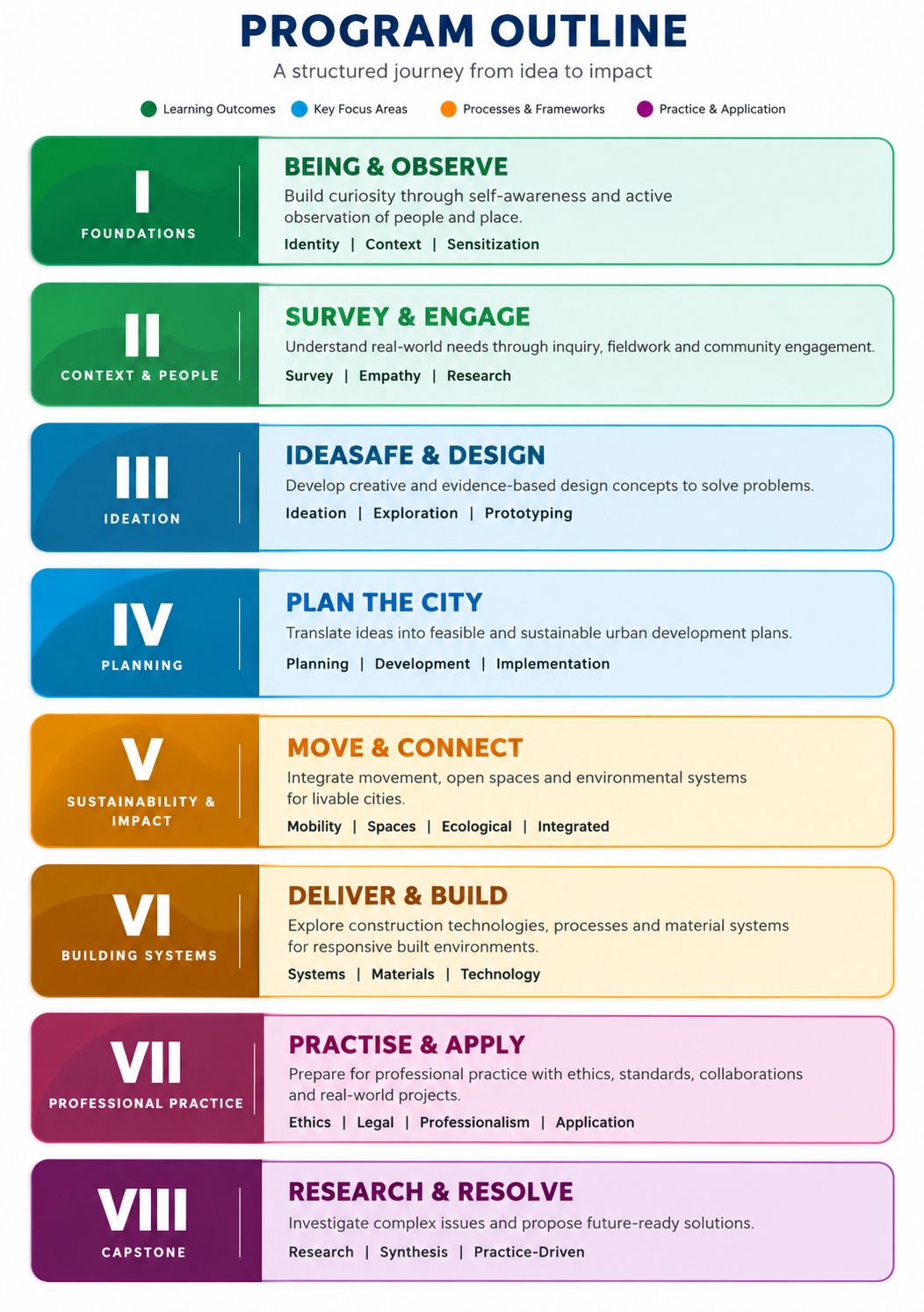
The scheme and syllabus for programs at BMS College of Architecture, Design & Planning (BMSCA D&P) are structured in accordance with the Visvesvaraya Technological University (VTU) regulations. The curriculum encompasses a diverse range of subjects, including Physical Planning, Regional Planning, Housing, digital tools, professional practice, and elective courses that allow students to specialize in their areas of interest.
Introduces design fundamentals through reading urban form and city patterns. Parallel courses in urban history, planning techniques, social-economic aspects, and quantitative methods establish foundational analysis skills. Digital tools (GIS, CAD basics) and communication literacy introduced. Students develop core competency in observing and interpreting how cities function spatially and socially.
Investigates neighborhoods and villages through field surveys and community engagement. Theory courses cover planning fundamentals, site surveying techniques, statistical analysis, and design principles. Emphasis on understanding local land use, settlement patterns, and stakeholder structures. Students develop skills in data collection, place reading at community scale, and design response to local planning challenges.
Applies development regulations and building standards to site design. Students integrate housing typologies, utilities infrastructure, circulation systems, and density controls. Theory covers planning frameworks, housing policy, utilities planning, and GIS analysis. Detailed site plans demonstrate compliance with building codes while maintaining design quality and contextual sensitivity. Specialization pathways emerge.
Develops city/metropolitan master plans addressing transportation, land-use zoning, heritage conservation, and resource management. Theory courses cover transportation systems, land economics, conservation policy, landscape ecology, and geoinformatics. Projects integrate policy frameworks with design for urban renewal and sustainable growth. Mid-program assessment; specialization tracks clarified. Students demonstrate city-scale planning competency.
Integrates transport infrastructure with urban design at metropolitan scale. Advanced theory addresses mobility systems, transit networks, walkability, and land-use-transport linkages. Courses include regional planning frameworks, project appraisal, public policy analysis, and specialization electives. Major project focus; students develop integrated transport and land-use strategy for complex urban regions.
Expands to regional/metropolitan scale addressing multi-nodal development, inter-city connectivity, and resource governance. Theory covers planning legislation, governance systems, implementation strategy, rural habitat planning, and infrastructure networks. Projects integrate policy-making and institutional frameworks for large-scale delivery. Second specialization elective completes. Students positioned for field-based professional practice. Summer internship (8 weeks) follows.
Eight-week applied learning placement with urban local bodies, planning consultancies, NGOs, or government departments. Students apply classroom knowledge to live planning projects, engage stakeholders, and document real-world challenges and solutions. Work-integrated learning bridges theory and professional practice. Internship findings, case studies, and supervisor feedback directly inform dissertation topic selection and research methodology in Semester 7.
Planning Dissertation as an independent research project addressing approved problems. Grounded in internship experience and studio investigation. Professional Practice & Ethics course (4 credits) completes the program. Capstone integration of planning theory, design, research rigor, and ethics.
+91-80-26622126/128


